Key takeaways
- From the first hire, employers owe payroll taxes and, once wages pass a small threshold, unemployment taxes. Nearly every state also requires workers' compensation. The federal health coverage requirement starts at 50 full-time employees, including full-time equivalents.
- In March 2026, 55% of private industry workers at establishments with fewer than 50 workers had access to an employer medical plan, compared with 86% at establishments with 100 or more. Even large employers do not cover everyone, because the federal rule applies only to full-time employees, and part-time staff and new hires in a waiting period often are not offered a plan.
- For hourly workers, cost weighs heavily on enrollment. The average employee share of single coverage takes about 6% of the weekly gross pay of someone earning $18 an hour for 30 hours. Family coverage at a small firm takes about a third.
- Paying the employee share pre-tax through a Section 125 plan lowers the cost for the worker and lowers payroll taxes for the employer.
- The benefits hourly workers value most are often simple and easy to use, with help available in the languages employees speak, such as Spanish.
In this guide
- What employee benefits should a small business offer?
- Why are benefits harder for small businesses with hourly teams?
- Which small business benefits are required, and which are optional?
- What does a health plan really cost an hourly worker?
- How do you build a benefits package hourly employees will use?
- Where does Activ8 Health fit in a small business benefits package?
- Frequently asked questions
What employee benefits should a small business offer?
Small business employee benefits fall into two groups. Some are required by law from your first hire, such as workers' compensation, unemployment insurance and the employer share of Social Security and Medicare taxes. The rest are your choice, such as health coverage, paid time off and retirement plans. For hourly and lower-wage teams, the best options are the ones employees can afford and will use.
This guide covers what the newest government data says about benefits at small employers, which benefits the law requires and when, what a health plan really costs an hourly worker each week, and how to build a package that fits a small business budget. Along the way you will hear from business leaders in childcare, senior living, staffing and restaurants who have worked through these same decisions.
Why are benefits harder for small businesses with hourly teams?
In its Employee Benefits in the United States report for March 2026, the Bureau of Labor Statistics found that 71% of private industry workers had access to an employer medical plan. At establishments with fewer than 50 workers, that figure was 55%. For part-time workers it was 23%, and for workers in the lowest-paid quarter of occupations it was 39%. BLS sorts workers by the typical pay for their type of job, so the "lowest-paid quarter" covers jobs such as cashiers, cooks and aides.
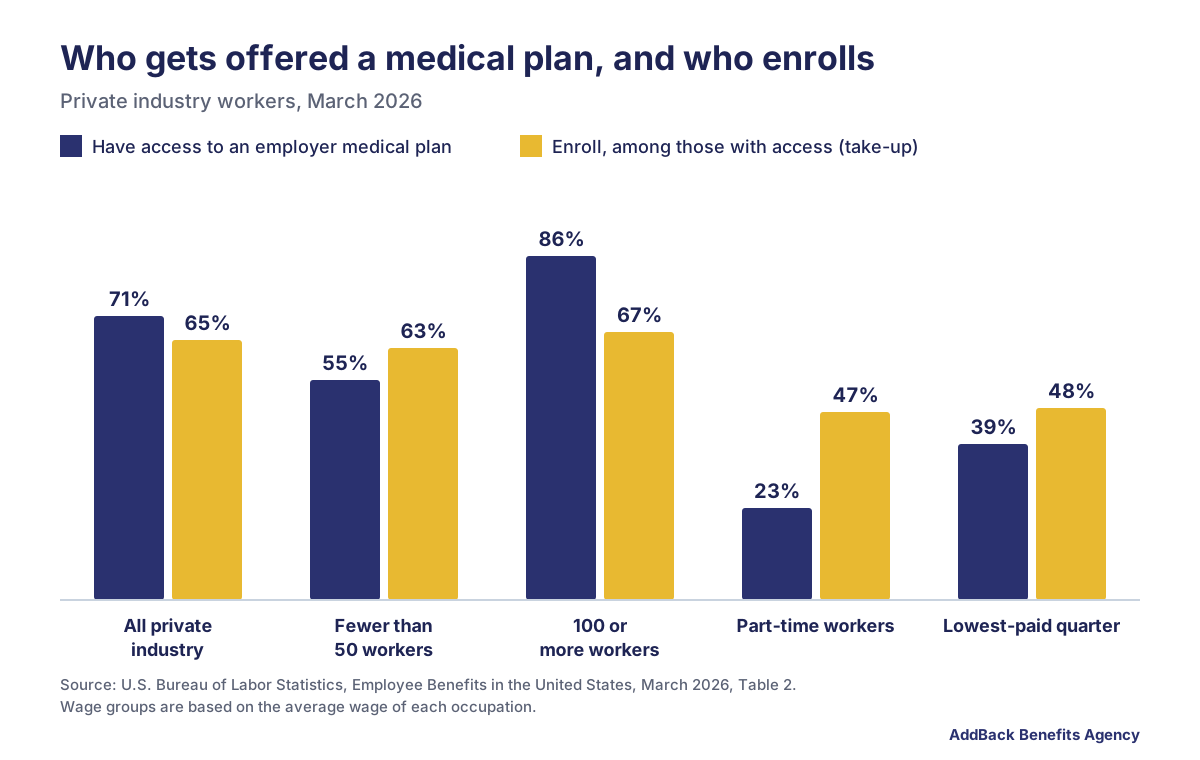
Access is only half of the story. BLS also measures take-up, the share of workers with access who enroll. Across private industry, 65% of workers offered a medical plan enrolled. Among the lowest-paid quarter of occupations, only 48% did, and among part-time workers 47% did. An employer can spend real money building a plan and still see many lower-paid workers decline it.
Jay Solomon has watched this play out. He is President and CEO of Aviva Senior Living, a not-for-profit senior living community in Sarasota, Florida, with caregivers, housekeepers and maintenance staff on its team. "I always thought health benefits were such a big, big portion of recruitment," he told me. "I'm embarrassed to say that it frustrates me that so many people in the workforce choose not to have health benefits." He described how, "when I got here eight years ago, I enriched our health benefits, believing that that was going to be the secret sauce" for recruiting. In the end, he said, word of mouth from his own staff did more to bring in new hires. The numbers above point to why so many workers pass on benefits like the ones Jay offered. Many lower-wage employees want coverage but cannot afford their share of the cost. Keep that in mind, because it is the problem the last section of this guide addresses.
The owner's side of the equation is just as hard. Tiffany Anna Madrid is the founder of Strong Foundations Learning Center, a childcare center in Thousand Palms, California. "It's really hard for me to say, come work for me at $18 an hour and do this really hard job," she said. "It's difficult to ask them that when I know they can go work at In-N-Out for $25 an hour." Public school teachers get benefits, she pointed out, but "for a small business like me, I can't afford to do that. If I could, I would. And I believe most childcare centers would." Raising tuition to pay for it was not a real option, she explained, because infant care at her center already cost families $1,500 a month.
Government cost data shows why her budget is so tight. The BLS Employer Costs for Employee Compensation report for June 2026 found that benefits made up 30.0% of total compensation across private industry, or $14.07 for every hour worked. At establishments with fewer than 50 workers, benefits were 25.9% of compensation, or $9.76 an hour.
Across private industry, insurance, mostly health coverage, is the largest benefit cost. The KFF 2026 Employer Health Benefits Survey put the average annual premium at $9,804 for single coverage and $28,303 for family coverage. With costs like these, it pays to know exactly which benefits you must provide before deciding what to add.
Figures from the BLS March 2026 and June 2026 releases and the KFF 2026 survey, current as of November 2026. These surveys are updated each year.
Which small business benefits are required, and which are optional?
A few benefits are required from your very first employee. You pay the employer share of Social Security and Medicare taxes, which is 7.65% of each employee's taxable wages. You also pay federal and state unemployment taxes, which fund benefits for workers who lose their jobs. Federal unemployment tax applies once you pay $1,500 or more in wages in a calendar quarter, so almost every business with staff owes it. Nearly every state also requires workers' compensation insurance to cover on-the-job injuries. Many states and cities require paid sick leave, and some require paid family leave or disability coverage, so confirm local rules with your payroll provider or an employment attorney.
Health coverage is where the size of your business matters most. Under the Affordable Care Act, the requirement to offer coverage applies to an "applicable large employer," which the IRS defines as an employer with at least 50 full-time employees, including full-time equivalent employees, on average during the prior year. A full-time employee is one who averages at least 30 hours of service a week, or 130 hours in a month. Part-time hours count too, because they are added up into full-time equivalents. An employer with many variable-hour workers can cross the 50 line without realizing it. Employers below 50 have no federal requirement to offer health coverage.
Once you offer a group health plan, federal COBRA continuation coverage applies if you had 20 or more employees in the prior year. Church plans and some government plans are exempt, and many states have similar rules for smaller employers. Very small employers may also qualify for the Small Business Health Care Tax Credit. To qualify, you need fewer than 25 full-time equivalent employees, average annual wages below a limit the IRS adjusts each year, coverage bought through the SHOP Marketplace, and an employer contribution of at least 50% of the employee-only premium. The credit can be worth up to 50% of the premiums you pay, and it can be claimed for two consecutive years.
Everything else is optional, from health, dental and vision coverage to retirement plans, extra paid time off and employee assistance lines. The challenge for an hourly workforce is that many of these options ask employees to pay part of the cost out of every check. To see why that matters, it helps to run the numbers for a real hourly wage.
What does a health plan really cost an hourly worker?
Employers pay most of the premium, but not all of it. According to the KFF 2026 survey, workers pay on average 18% of the premium for single coverage and 27% for family coverage. In dollars, that is $1,672 a year for single coverage and $7,471 a year for family coverage. At small firms (10 to 199 workers in KFF's survey), the average worker contribution for family coverage is higher, at $9,687 a year. The table below shows those amounts as a share of weekly gross pay for three hourly wages at 30 hours a week.
| Share of weekly gross pay (30 hours a week) | $15 an hour | $18 an hour | $22 an hour |
|---|---|---|---|
| Weekly gross pay | $450 | $540 | $660 |
| Average single-coverage contribution, $32.15 a week | 7.1% | 6.0% | 4.9% |
| Average family-coverage contribution, $143.67 a week | 31.9% | 26.6% | 21.8% |
| Average family-coverage contribution at firms with 10 to 199 workers, $186.29 a week | 41.4% | 34.5% | 28.2% |
Weekly contributions are the KFF 2026 annual averages divided by 52.
For a parent earning $18 an hour, family coverage at an average small firm would take more than a third of the paycheck before taxes. That goes a long way toward explaining the take-up numbers Jay Solomon finds so frustrating. Hourly workers see the deduction every payday, and cost often decides whether they enroll.
Amy Clary, CEO of the Texas staffing firm Keystaff, hears the same thing from the employers she places workers with. "they're saying, we offer great benefits. That doesn't really seem to keep people. What keeps people is the pay rate," she said. She has seen candidates take a higher pay rate with no benefits, because "they like to feel like they're making what they think they're worth." For an hourly worker, a premium that costs a large share of each check can be hard to justify, even when the coverage is valuable.
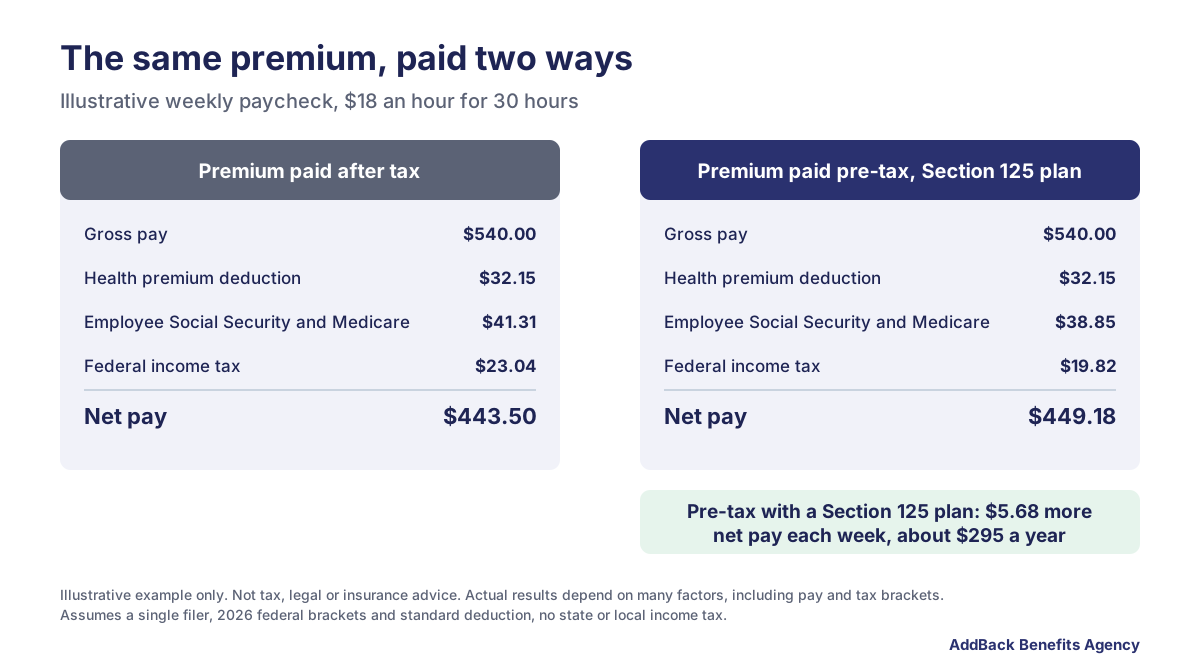
One fix lowers that cost without changing the plan. Congress created Section 125 of the tax code so employees can pay for benefits without being taxed on that money, which makes benefits more affordable. Without a Section 125 plan in place, premium deductions are taken after tax. With a Section 125 plan, the employee's share comes out before Social Security, Medicare and federal income taxes, as described in IRS Publication 15-B. Here is the same $18-an-hour worker paying the average single-coverage contribution both ways.
| Weekly paycheck, $18 an hour for 30 hours | Premium paid after tax | Premium paid pre-tax through a Section 125 plan |
|---|---|---|
| Gross pay | $540.00 | $540.00 |
| Health premium deduction | $32.15 | $32.15 |
| Wages subject to Social Security and Medicare | $540.00 | $507.85 |
| Employee Social Security and Medicare (7.65%) | $41.31 | $38.85 |
| Federal income tax | $23.04 | $19.82 |
| Net pay | $443.50 | $449.18 |
| Employer Social Security and Medicare (7.65%) | $41.31 | $38.85 |
Paid pre-tax through a Section 125 plan, the same premium costs this employee $5.68 less each week, about $295 a year. The employer saves money on payroll taxes through this arrangement too, $2.46 a week for this employee, or about $128 a year. The federal income tax line uses the 2026 federal tax brackets and the $16,100 standard deduction for single filers.
Tax brackets and the standard deduction are for 2026 from IRS Rev. Proc. 2025-32, current as of November 2026, and are adjusted annually.
A Section 125 plan should have a written plan document, so ask your third-party plan administrator or a benefits attorney to set it up correctly. Lowering the cost of a benefit helps, but hourly workers also have to find it worth using, which is where plan design comes in.
How do you build a benefits package hourly employees will use?
Start by asking your employees what would help them. The answer is often simpler and cheaper than owners expect. The business leaders I talk to who run hourly teams find that the most valued benefits solve an everyday problem quickly and simply.
Alistair Levine has seen this firsthand. He previously owned Vine Hospitality Group, a group of restaurants in the San Francisco Bay Area, and was a partner at Kitchen Sync, which runs bookkeeping, payroll, HR and other back-office work for independent restaurant groups. Turnover is a constant challenge in his industry. "most restaurants are running in excess of 100% turnover rate annualized," he said.
When we talked about keeping good employees, he pointed to one benefit above all: "our number one benefit people love is just an emergency bilingual helpline. It's our single cheapest benefit we provide." Employees call it for emergency mental health support or for referrals to a doctor or an attorney. "when we've surveyed employees in the past, it is their favorite benefit," he said. Because so many of the group's staff were native Spanish speakers, offering it in both languages mattered. "I think it's about meeting people where they are."
That lesson applies well beyond restaurants. A health plan with a high deductible may go unused by a worker earning $18 an hour, because the deductible makes every visit feel expensive. KFF found that among covered workers at small firms with a deductible, the average single-coverage deductible was $2,624 in 2026. That cost keeps many employees from getting care at all. Benefits with no copays or deductibles, such as telehealth, therapy and common prescriptions, are easier for hourly employees to use and to appreciate.
Language matters for the same reason. If a large share of your team speaks Spanish, the member line, enrollment materials and reminders should too.
Not every valued benefit is insurance. Jay Solomon added a way to get his team paid faster. "We now have a system where I can actually pay my employees daily as opposed to waiting for a week or two weeks for a paycheck," he said. For workers living paycheck to paycheck, timing can matter as much as the amount.
Finally, measure what your benefits are doing. Turnover is the clearest signal, and it has a real cost in hiring, training and lost productivity. Our employee turnover calculator shows your current rate and what it costs, so you can compare before and after a benefits change. With the basics in place, the next question is whether a plan exists that gives hourly workers real health benefits without adding to their weekly cost.
Where does Activ8 Health fit in a small business benefits package?
Activ8 Health is a fully insured fixed indemnity insurance plan that employers offer through a Section 125 cafeteria plan. While it works for many environments, it was built with lower-wage, hourly, high-turnover or variable-hour workforces in mind. Enrolled employees get virtual urgent care, virtual primary care, psychiatry, therapy and prescriptions from a 190-drug list with no copays and no deductibles, plus a hospital cash benefit.
Activ8 Health is stand-alone coverage. It is not major medical and it does not replace it. Nearly all employers that offer it keep their major medical plan, as we explain in how Activ8 works with existing coverage. It is also not minimum essential coverage, so it does not satisfy the ACA requirement for employers with 50 or more full-time employees. If you need minimum essential coverage, we can help you find the most cost-effective plan available.
Eligible employees who enroll see higher take-home, so cost is not the barrier it is with a traditional plan. Many part-time employees qualify on the same terms as full-time staff. Activ8, not the employer, leads employee education and onboarding. For the employer, the payroll tax savings always exceed the Activ8 fee so it creates a net financial gain.
Activ8 Health works with employers that have about 20 or more W-2 employees and is available in most states and Washington, D.C. The plan is underwritten by Federal Life Insurance Company, which is rated A- (Excellent) by AM Best. Activ8 Health, a Bain Capital Insurance portfolio company. You can find answers to more common questions on our FAQ page.
Activ8 Health is not major medical insurance and is not an ACA qualified health plan. Activ8 Health is a fully insured product underwritten by Federal Life.
Frequently asked questions
What benefits are small businesses required to offer?
+
The federal basics are the same for every employer: the employer share of Social Security and Medicare taxes, unemployment insurance and, in nearly every state, workers' compensation. What varies is state and local law. A business with locations in several cities may face different paid sick leave rules, and sometimes different paid family leave or disability rules, in each one. Your payroll provider or an employment attorney can map the rules for each location.
Do small businesses have to offer health insurance?
+
Not under federal law if you have fewer than 50 full-time employees, including full-time equivalents. The ACA requirement applies to applicable large employers with 50 or more. A full-time employee averages at least 30 hours a week or 130 hours a month, and part-time hours are combined into full-time equivalents. Some employers below 50 offer coverage anyway to compete for workers, and those with fewer than 25 full-time equivalents may qualify for the Small Business Health Care Tax Credit.
Do part-time employees get benefits?
+
Federal law does not require employers to offer health coverage to employees who average fewer than 30 hours a week. Many employers do not, and BLS found that only 23% of part-time private industry workers had access to an employer medical plan in March 2026. Some benefits can still include part-time staff. State paid sick leave laws often cover them, and some plans, including Activ8 Health, base eligibility on pay and deductions rather than hours alone.
How much do employee benefits cost a small business?
+
BLS found that benefits averaged $9.76 an hour, or 25.9% of total compensation, at private establishments with fewer than 50 workers in June 2026. That figure includes legally required costs such as payroll taxes and workers' compensation, plus insurance, paid leave and retirement. Health insurance is one of the largest optional costs. KFF's 2026 survey put the average premium at $9,804 a year for single coverage and $28,303 for family coverage, with employers paying most of it.
What is the most affordable way to offer benefits to hourly employees?
+
Start by asking employees what they value, because simple benefits such as a bilingual help line or faster pay can matter more than an expensive plan few people use. A Section 125 plan lets any employee premiums come out pre-tax, which lowers the cost for both the employee and the employer. Look for benefits with no cost at the point of care, so workers use them. Then track turnover to see whether the changes are working.
See whether Activ8 Health fits your team
Curious whether Activ8 Health could fit alongside the benefits you already offer and help reduce your overall cost of providing employee benefits? Book a call and we will walk through how it could work for your team.
Book a call with Anthony
About the author
Anthony V. Codispoti is the owner of AddBack Benefits Agency and the host of The Inspired Stories Podcast, where he has interviewed more than 600 business owners about how they hire, keep and take care of their teams. He has started, owned, and successfully exited businesses since the mid-1990s. He has seen the pain of increasing health insurance costs and shrinking coverage first hand. Today he helps employers evaluate Activ8 Health as a way to reduce costs and increase coverage.
This article is for general information only. It is not tax, legal or financial advice. Every employer's and employee's situation is different. Talk with your own tax adviser or attorney before making decisions. Activ8 Health is not major medical insurance and is not an ACA qualified health plan. Activ8 Health is a fully insured product underwritten by Federal Life.
Claim payments are subject to Rev. Rul. 69-154.