Key takeaways
- A Section 125 plan lets employees pay their share of qualified benefits, such as health premiums, before taxes are taken out.
- Paying before taxes lowers the employee's income and payroll taxes and the employer's payroll taxes.
- The health plan itself does not change. Only the timing of the premium deduction changes.
- Every plan needs a written plan document, and some owners cannot participate.
- "Section 125 plan" describes how a benefit is paid for, not what the benefit is. Check the carrier, the state filing and what triggers a payment.
In this guide
What is a Section 125 plan?
A Section 125 plan is a written employer plan that lets employees pay for certain benefits, such as their share of health, dental and vision premiums, with pre-tax dollars. It gets its name from Section 125 of the Internal Revenue Code. You will also hear it called a cafeteria plan, because it lets employees pick and choose from a menu of benefits. Congress added Section 125 to the tax code in 1978 so employees could pay for these benefits without being taxed on the money they spend on them. That makes benefits more affordable for employees, and it lowers the employer's payroll taxes too.
Many employers already have a plan that falls under the Section 125 umbrella, even if that's not how they refer to it. It is the reason the health insurance deduction on a pay stub is marked "pre-tax." But many owners never look closely at how their plan is set up, what else it could hold, or which rules keep it compliant. This guide explains why that matters more every year, how the plan works, what it can hold and how to set it up correctly.
How employees pay for benefits matters more every year
Health coverage keeps getting more expensive, and employees carry a real share of the bill. The KFF 2026 Employer Health Benefits Survey put the average family premium at $28,303, up 5% from the year before. Single coverage averaged $9,804. On average, workers paid $1,672 a year toward single coverage and $7,471 toward family coverage. For a full-time worker earning $17 an hour, $7,471 is more than two months of gross wages.
Some employers are seeing much bigger jumps than the averages. Mike Ehrle, CEO and Founder of Finparency, has advised small and midsize employers on their benefits, most of them with 50 to 200 employees. He described this as an era when clients, "especially in the fully insured space, are seeing 30, 40, 50% medical renewals."
Owners feel that pressure from two directions. They need good benefits to keep good people, and the cost of those benefits keeps climbing. Scott Smith, CEO and President of Max Hospitality, runs 10 restaurants in Connecticut and western Massachusetts, most of them around Hartford. Many of his managers and chefs have been with the company for decades, and he knows competitors would love to hire them. "Everybody opening up a new restaurant knows I'm going to knock on the back door of Max's and if I can get a guy from there, it'll make my opening much better," he said. Benefits are part of how Max's keeps those people.
“Everybody opening up a new restaurant knows I'm going to knock on the back door of Max's and if I can get a guy from there, it'll make my opening much better.”
 Scott Smith, CEO and President, Max Hospitality
Keeping them is getting more expensive, even in good years. "We have a great year, our claims are at a low percentage compared to what our premiums are, but we still see every year the premiums go up and go up and go up," Smith said. Max Hospitality shares that cost with its employees, so the increases land on them as well. As he put it, "the real pain of that is that the employees have to burden part of that as well."
The squeeze is hardest for employers with hourly teams, and it starts with whether there are benefits to offer at all. In March 2026, only 23% of part-time private-industry workers had access to employer medical coverage, compared with 87% of full-time workers, according to the Bureau of Labor Statistics. KFF found a similar gap by pay level. Among firms that offer health benefits, 47% of workers at firms with a relatively large share of lower-wage workers were covered by their own employer's plan, compared with 61% at firms with fewer of them. KFF defines lower-wage workers as those earning $38,000 or less a year, the bottom quarter of earnings, and counts a firm as having a large share when at least 35% of its workers fall in that group.
$28,303
Average family premium in 2026
KFF Employer Health Benefits Survey
$7,471
What workers paid each year toward family coverage
KFF Employer Health Benefits Survey
23%
Part-time private-industry workers with access to employer medical coverage
BLS, March 2026
The business leaders I talk to see this gap firsthand. Jarred Mason is Chief Operating Officer of Standard Market, a chef-driven gourmet market in Westmont, Illinois. His entry-level staff get benefits after a waiting period, the option to pay into a retirement plan, and vacation time. Mason is direct about the trade-off. "We compete the most on pay because our benefits package is not as strong as other competitors have," he said. As he put it, "we're one company. On the smaller side."
Kaye Boehning, Founder and Director of Tomorrow's Promise Montessori Schools in Huntsville, Texas, faces a related decision. Her schools are nearing 50 employees, which brings a new set of rules she has to learn. She described the question in front of her plainly. "if you grow, can you afford the health insurance and can you afford the different requirements and things like that," she said. She also noted that many of her employees would rather have the money in their paycheck than a health insurance deduction, "because they need it."
The 50-employee mark she mentioned matters under federal law. Under the Affordable Care Act, an employer that averaged at least 50 full-time employees, including full-time equivalents, during the prior year is an applicable large employer. If it does not offer affordable, minimum value coverage to its full-time employees, it may owe an employer shared responsibility payment. For employers approaching that line, every benefit dollar has to stretch further.
That is the position most employers are in, whatever their size or workforce. They cannot make premiums stop rising. What a Section 125 plan does is make the employee's share cost less. The health plan itself is the same either way. What changes is when the employee's share comes out of the paycheck. With a Section 125 plan in place, it comes out before taxes. Without one, it comes out after taxes. That means every dollar of premium costs the employee a full dollar. Many employers who offer group coverage already have a Section 125 plan, often set up by their broker or payroll provider. Some do not, and some coverage cannot run through one at all. For example, employees who buy an individual plan through the public marketplace (the ACA exchange) with an individual coverage HRA (ICHRA) must pay any premium the HRA does not cover with after-tax dollars. The rest of this guide explains how the pre-tax side works.
How a Section 125 plan works
Employees decide whether to enroll in a benefit, and the cost is part of that decision. A Section 125 plan lowers that cost. Without one, an employee's share of the premium comes out of their pay after taxes. With one, it comes out before taxes, so the employee is not taxed on the money used to pay for the coverage. Paying with pre-tax dollars instead of after-tax dollars lowers what that coverage costs them.
In practice it works like this. During enrollment, the employee elects a benefit. Each payday, payroll subtracts the cost of that benefit from gross pay first. Federal income tax, Social Security tax and Medicare tax are then calculated on the smaller amount that is left. In many states and local jurisdictions, income taxes are calculated on the smaller amount as well.
Social Security and Medicare taxes together are often called FICA. According to IRS Topic 751, the employee pays 6.2% for Social Security and 1.45% for Medicare, for a total of 7.65%. The employer pays a matching 7.65%. FICA is calculated on taxable wages. So when a pre-tax deduction lowers an employee's taxable wages, both the employee's share and the employer's share go down. That is why a Section 125 plan can lower costs for both the employee and the employer. Here is what the difference looks like in a paycheck.
Take an hourly employee who earns $2,800 a month in gross wages. Her share of the company health plan premium is $100 a month. To keep the math simple, federal income tax is shown as a flat 12% of taxable wages, and state and local taxes are left out. Real withholding depends on each employee's W-4 and tax bracket.
| Per month | Premium paid after tax (no Section 125 plan in place) | Premium paid pre-tax (Section 125 plan) |
|---|---|---|
| Gross wages | $2,800.00 | $2,800.00 |
| Pre-tax premium deduction | $0.00 | $100.00 |
| Taxable wages | $2,800.00 | $2,700.00 |
| Federal income tax (12%) | $336.00 | $324.00 |
| Employee Social Security and Medicare (7.65%) | $214.20 | $206.55 |
| After-tax premium deduction | $100.00 | $0.00 |
| Net pay | $2,149.80 | $2,169.45 |
| Employer Social Security and Medicare contribution (7.65%) | $214.20 | $206.55 |
Here is what the table shows. Her gross wages and her coverage are identical in both columns. The only difference is when the $100 premium comes out. In the first column, taxes are calculated on her full $2,800, and then the premium comes out of what is left. In the second column, the premium comes out first, so taxes are calculated on $2,700. She owes $12 less in federal income tax and $7.65 less in Social Security and Medicare. Her net pay is $19.65 higher each month under the Section 125 plan, even though she is paying the same premium for the same coverage.
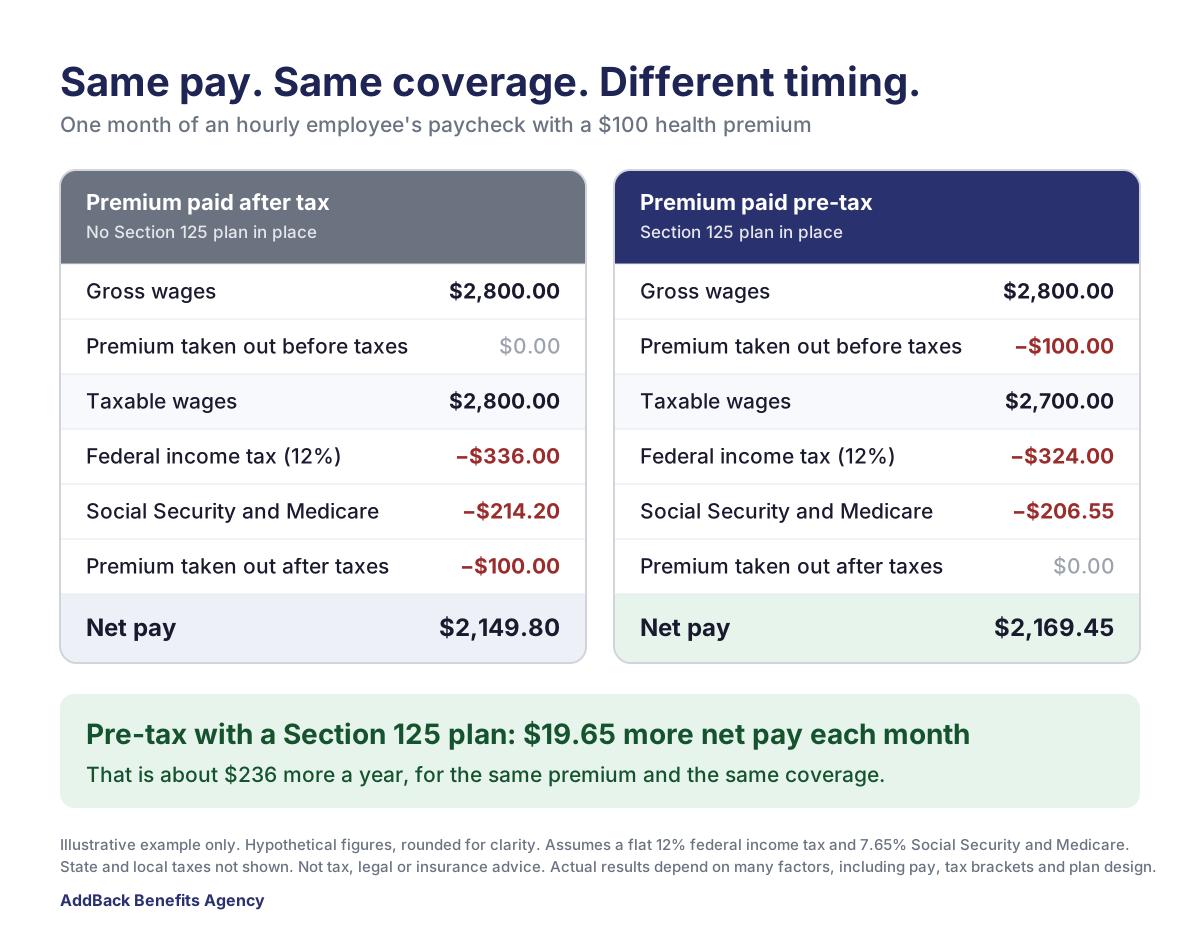
Over a year, that is about $236 more in her pocket. For an hourly employee, that can cover a utility bill or a few tanks of gas. The premium is still a real cost to her. The Section 125 plan simply makes it a smaller one.
The employer saves money on payroll taxes through this arrangement, and it adds up. Because her taxable wages are $100 lower each month, the employer's matching Social Security and Medicare drop from $214.20 to $206.55, a savings of $7.65 a month, or about $92 a year. With 50 employees paying premiums the same way, the employer pays about $4,590 less in payroll taxes each year. The larger the employee share of premiums, and the more employees who pay through the plan, the larger both numbers get. The same math applies to every benefit that runs through the plan, so the next question is which benefits can.
What a Section 125 plan can include
Not every benefit can run through a Section 125 plan. According to IRS Publication 15-B, qualified benefits include accident and health benefits, dependent care assistance, adoption assistance, group-term life insurance coverage, health savings account contributions and elective contributions to a qualified 401(k) plan. Accident and health benefits cover a lot of ground. They include major medical, dental and vision premiums, and many supplemental insurance policies, such as accident, critical illness and fixed indemnity coverage.
Some things are specifically left out. Educational assistance, meals, commuting benefits and employee discounts cannot be paid through a Section 125 plan.
Within those rules, most employers use one or more of these common setups:
| Setup | What it does | 2026 limit | Often a fit when |
|---|---|---|---|
| Premium-only plan (POP) | Employees pay their share of insurance premiums pre-tax | No set dollar limit | The employer offers any insured benefit with an employee cost |
| Health flexible spending account (FSA) | Employees set aside pre-tax money for out-of-pocket medical costs | $3,400 per employee | Employees have predictable costs like prescriptions or copays |
| Dependent care FSA (a separate account) | Employees set aside pre-tax money for the care of a child under 13, or a spouse or dependent who cannot care for themselves, so they can work | $7,500 per household (half that if married filing separately) | Many employees have young children or care for a parent |
Limits are for 2026, as published in IRS Publication 15-B (2026), and are current as of October 2026. The IRS adjusts some limits each year, so check the current figures before making plan decisions.
Each setup does a different job. A premium-only plan, often called a POP, is the simplest. It does one thing. It lets employees pay their share of insurance premiums before taxes. There is nothing for employees to manage and no money to forecast.
A health flexible spending account takes more planning. Employees set aside part of each paycheck and use that money for out-of-pocket medical costs like copays, deductibles and prescriptions. It is a use-it-or-lose-it setup. Money left at the end of the year is generally forfeited, although a plan may allow a small carryover or a short grace period. A dependent care FSA is a separate account with its own limit. It works the same way, but it pays for the care of a child under 13, or of a spouse or dependent who cannot care for themselves. This allows the employee to work.
For a workforce that is mostly hourly or part-time, the premium-only plan is usually the best fit. Both setups take money out of each paycheck, but they ask different things of employees. An FSA asks employees to guess a full year of out-of-pocket costs in advance, and money they don't spend in time is generally lost. That is a hard ask when hours and paychecks vary week to week. A POP involves no guessing. The deduction is the set premium for coverage the employee already chose, and nothing is forfeited. Whichever setup an employer chooses, though, the savings only hold if the plan is run by the rules.
Setting up a Section 125 plan and keeping it compliant
Most of those rules are simple, but they are easy to miss, especially at smaller companies. Mike Ehrle explained why. Most of the small business employers he advised "have an HR leader normally with a compensation or a talent background, not a benefits background." So the details below often land on someone who already has a dozen other jobs. Here are the rules employers most often misunderstand, in the order they usually come up.
1. Put a written plan document in place before the plan year starts. Every Section 125 plan needs one, and it should be adopted before the plan year it covers begins. The document spells out who is eligible, which benefits are offered and how employees enroll. Most employers don't need to write one from scratch. Many benefits brokers can arrange one, often through a third-party plan administrator, and many payroll providers offer one as part of their service.
2. Know who can participate. W-2 employees can. Some owners cannot. Under IRS Publication 15-B, a person who owns more than 2% of an S corporation is not treated as an employee for cafeteria plan purposes. Partners in a partnership and sole proprietors are in the same position, because the tax code treats them as self-employed rather than as employees. This surprises many small business owners, and it can reach further than expected. In an S corporation, ownership rules attribute shares to certain family members, so an owner's spouse, children, grandchildren or parents who work in the business may be treated as owners too.
3. Make sure the plan does not favor the people at the top. Section 125 has nondiscrimination rules, and their purpose is simple. The plan's tax benefits should not mainly go to the highest-paid people or the owners. There are tests for who is eligible to join, for which benefits are available, and for how much of the total benefit goes to the top. If a plan favors highly compensated employees, those employees can lose the tax benefit and owe tax on what they chose.
There is also a key employee test. Under Publication 15-B, a plan favors key employees if more than 25% of the total nontaxable benefits go to them. A company with mostly hourly staff and broad enrollment is less likely to run into trouble. A small company where the owners and a few managers make most of the elections should have its third-party plan administrator or a benefits attorney run the nondiscrimination tests.
Small employers have a safe harbor worth knowing about. An employer with 100 or fewer employees can set up a simple cafeteria plan, which treats the nondiscrimination tests as met. In exchange, the employer has to make a required contribution toward employees' benefits and offer the plan to nearly all employees who worked at least 1,000 hours in the prior year.
4. Set up payroll correctly. Each pre-tax deduction has to be coded as pre-tax in the payroll system, so that income tax and FICA are calculated on the reduced amount. W-2 reporting has to match what actually happened.
"Section 125 plan" is a payment method, not a product
Many employers mix up two different things. "Section 125" describes how a benefit is paid for. It does not describe the benefit itself. Major medical, dental, vision, supplemental coverage like accident or critical illness insurance, fixed indemnity insurance, FSAs and dependent care accounts can all run through the same Section 125 plan. Fixed indemnity insurance pays a set dollar amount when a covered medical event happens, regardless of what the event actually cost. Calling any one of these benefits "a Section 125 plan" is like calling a car "a loan." It tells you how it was paid for, not what you are buying.
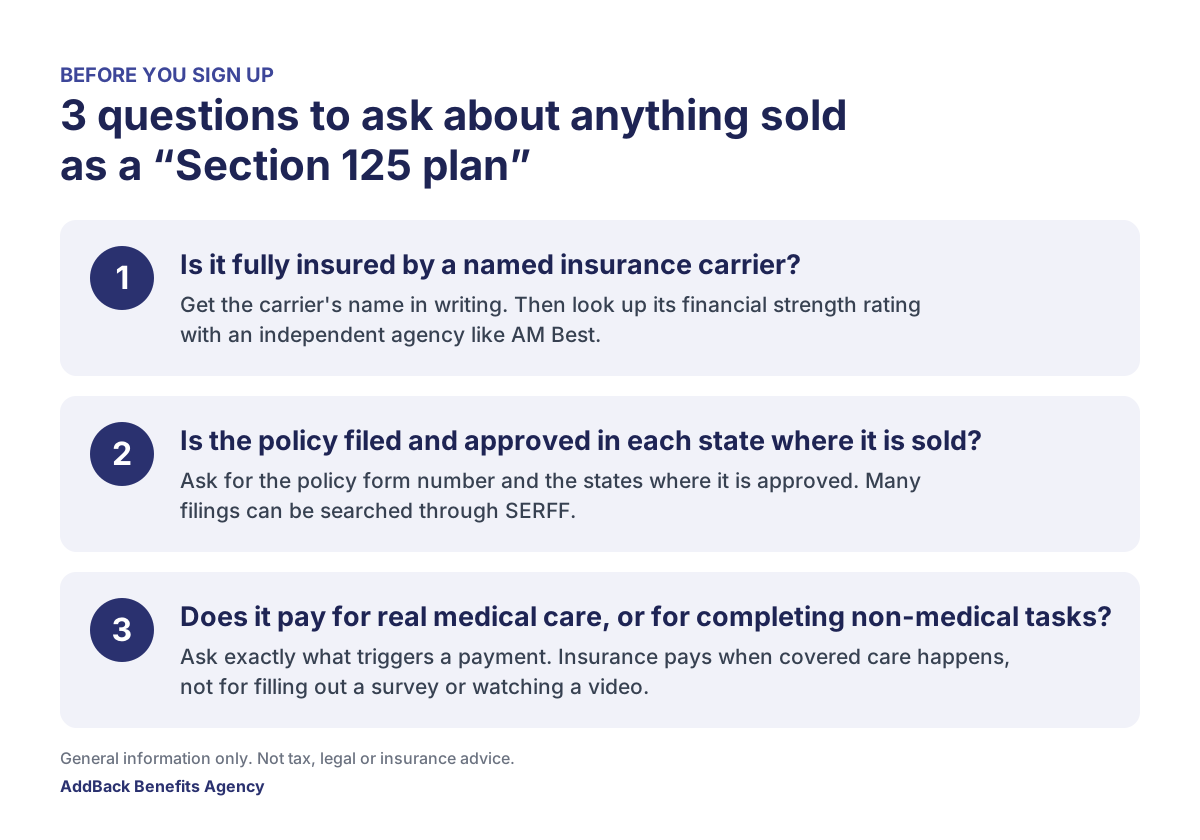
This distinction matters because employers are now pitched products sold simply as "a Section 125 plan." The label sounds official, and it does describe how the premium is paid. But it says nothing about what stands behind the product. Some are filed insurance policies from established carriers. Others are arrangements that pay employees for completing wellness activities, which is something that has run afoul of the IRS. Before signing up for anything sold under that name, it is worth asking these three questions.
1. Is it fully insured by a named insurance carrier? In a fully insured plan, an insurance company takes on the financial risk and pays the claims. The employer and the vendor do not. That matters most when claims run higher than expected, because the insurer is the one obligated to pay them. Ask the vendor to name the carrier in writing. Then look up that carrier's financial strength rating from an independent agency like AM Best. If the vendor cannot name a carrier, or describes the plan as "self-funded" or run by the vendor itself, that is a very different arrangement with compliance implications.
2. Is the policy filed with and approved by the insurance department in each state where it is sold? Insurance policies are filed with state regulators, who review them before they can be sold. Those filings are public, and many can be searched online through the system state regulators use, called SERFF. Ask for the policy form number and the states where it is approved. A legitimate insurer will have this information readily available. If a product cannot point to a filed policy, ask why.
3. Does it pay for real care, or does it pay people for doing activities? Insurance pays when something covered happens, such as a medical procedure, a doctor visit, a therapy session, a prescription, health coaching or a hospital stay. Some products sold as "Section 125 plans" instead pay employees for completing non-medical tasks, such as filling out a health survey or watching a short video. If those payments are not tied to medical care with a valid CPT billing code, there may be compliance issues.
Activ8 Health is one example of insurance that runs through a Section 125 plan. It is a fully insured fixed indemnity plan underwritten by Federal Life Insurance Company, which is rated A- (Excellent) by AM Best. Employees pay the premium pre-tax, and Activ8 leads the employee education and onboarding process. It includes access to care like virtual primary care, urgent care, psychiatry, counseling and therapy, and prescriptions with no copays and no deductibles for covered services. It also includes a hospital cash benefit. It is offered by AddBack Benefits Agency. Activ8 Health is a Bain Capital Insurance portfolio company. You can learn more about Activ8 Health here, or read What Is Activ8 Health? and How Activ8 Works with Existing Coverage. Employers with hourly teams can also see our guide to small business employee benefits.
Activ8 Health is not major medical insurance and is not an ACA qualified health plan. Activ8 Health is a fully insured product underwritten by Federal Life.
Frequently asked questions
Is a Section 125 plan the same as a cafeteria plan?
+
Yes. "Section 125 plan" refers to the section of the tax code that allows it. "Cafeteria plan" is the everyday name, because employees choose from a menu of benefits. You may also hear "flex plan," or "premium-only plan" (POP) for the simplest version. They all describe the same basic arrangement: employees choose benefits and pay for them with pre-tax dollars.
Is a Section 125 plan required by law?
+
No federal law requires an employer to have one. But an employer cannot take employee premiums out of pay before taxes without one.
Do we need a plan document?
+
Yes. Every Section 125 plan should have a written plan document in place before the plan year starts. The document describes who is eligible, which benefits are offered and how employees enroll. Depending on the setup, it may come from a benefits broker, a payroll provider, a third-party plan administrator or a benefit provider.
Who is not eligible for a Section 125 plan?
+
Self-employed owners, and owners the tax code treats the same way, cannot participate. That includes sole proprietors, partners in a partnership and anyone who owns more than 2% of an S corporation. Owner-employees of a C corporation can participate. In an S corporation, family members of an owner may also be treated as owners. Beyond that, the plan document sets eligibility for employees, such as a waiting period or minimum hours, as long as the rules pass the nondiscrimination tests.
Is there a minimum number of employees?
+
Section 125 itself has no minimum headcount. But because sole proprietors, partners and owners of more than 2% of an S corporation cannot participate, the plan needs at least one eligible employee to be useful. Separately, the insurance carriers whose coverage runs through the plan may set their own group minimums, and those vary by carrier and state.
Can part-time employees be included?
+
Yes. The plan document sets who is eligible, and many employers include part-time staff. Some set a minimum number of hours. Whatever the rules are, they have to pass the nondiscrimination tests, so they cannot be written to favor highly paid employees or owners.
How does a pre-tax premium lower payroll taxes?
+
Social Security and Medicare taxes are calculated on taxable wages. A pre-tax deduction lowers taxable wages, so both the employee and the employer pay 7.65% less on the amount deducted, for wages under the Social Security wage base. On a $100 monthly premium, that is $7.65 a month for each side. See the paycheck example above for the full breakdown.
See whether Activ8 Health fits your team
Curious whether Activ8 Health could fit alongside the benefits you already offer and help reduce your overall cost of providing employee benefits? Book a call and we will walk through how it could work for your team.
Book a call with Anthony
About the author
Anthony V. Codispoti is the owner of AddBack Benefits Agency and the host of The Inspired Stories Podcast, where he has interviewed more than 600 business owners about how they hire, keep and take care of their teams. He has started, owned, and successfully exited businesses since the mid-1990s. He has seen the pain of increasing health insurance costs and shrinking coverage first hand. Today he helps employers evaluate Activ8 Health as a way to reduce costs and increase coverage.
This article is for general information only. It is not tax, legal or financial advice. Every employer's and employee's situation is different. Talk with your own tax adviser or attorney before making decisions. Activ8 Health is not major medical insurance and is not an ACA qualified health plan. Activ8 Health is a fully insured product underwritten by Federal Life.
Claim payments are subject to Rev. Rul. 69-154.